




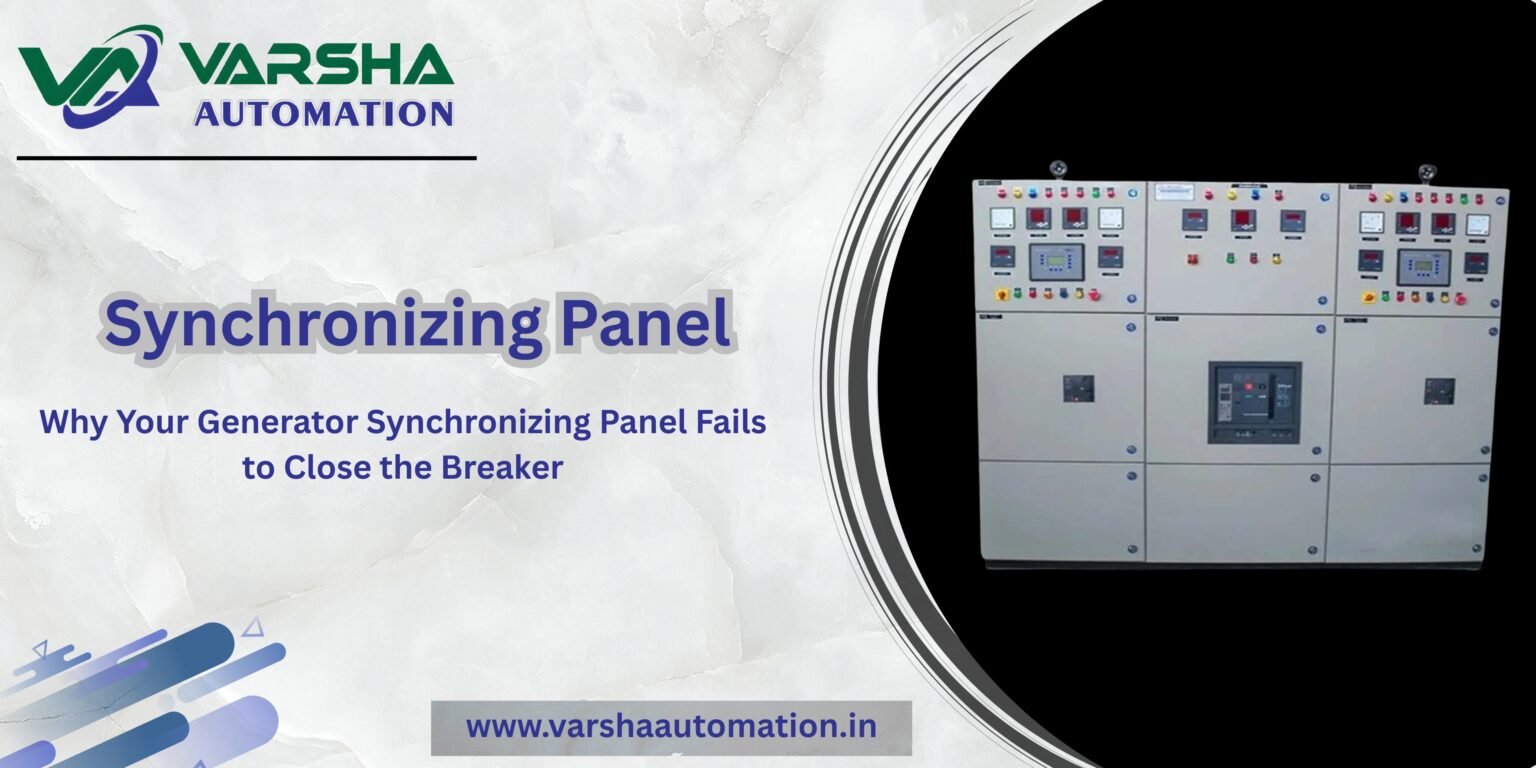
Why Your Generator Synchronizing Panel Fails to Close the Breaker
In industrial facilities where continuous power is non-negotiable, diesel generator sets provide vital backup power. During a grid failure, multiple generators must often run in parallel to handle heavy plant loads. The synchronizing panel is responsible for matching the incoming generator’s voltage, frequency, and phase angle with the live busbar before securely closing the circuit breaker.
When the panel refuses to issue the close command, it leaves backup power stranded. Understanding the underlying interlocks helps maintenance teams resolve the issue quickly.
Common Causes of Synchronizing Failures
1. Phase Angle or Slip Frequency Out of Range
A synchronizing relay will block the breaker from closing if the phase difference or frequency difference (slip) between the incoming generator and the live bus exceeds safe programmed thresholds. Even a microscopic timing mismatch can prevent closure to protect equipment from massive mechanical shock.
2. Voltage Mismatch Between Generator and Bus
If the incoming generator’s voltage is adjusted too high or too low compared to the running busbar, the sync controller’s voltage window interlock will lock out the breaker close signal.
3. Faulty Voltage Transformers (PTs) or Feedback Wiring
The controller relies entirely on accurate voltage and phase data from potential transformers (PTs). Loose secondary wiring, blown PT fuses, or calibration drift can feed false data into the controller, halting the synchronization sequence.
Step-by-Step Troubleshooting Guide
Check Synchronization Window Settings: Review the controller programming to ensure the phase angle window, slip frequency, and voltage differential limits are appropriately configured for your generators.
Inspect PT Fuses and Connections: Verify that all potential transformer fuses are intact and that secondary measurement voltages match precisely across all phases on both sides of the breaker.
Test the Breaker Trip/Close Mechanism: Manually verify that the electrical trip and close coils on the heavy-duty circuit breaker receive clean signals from the controller without mechanical binding.
Conclusion
Ensuring reliable power transition during emergencies protects your facility from production halts and equipment damage. When building out your emergency power infrastructure, integrating a precision-engineered Synchronize Panel ensures seamless parallel operation, exact phase matching, and dependable power distribution when you need it most.