




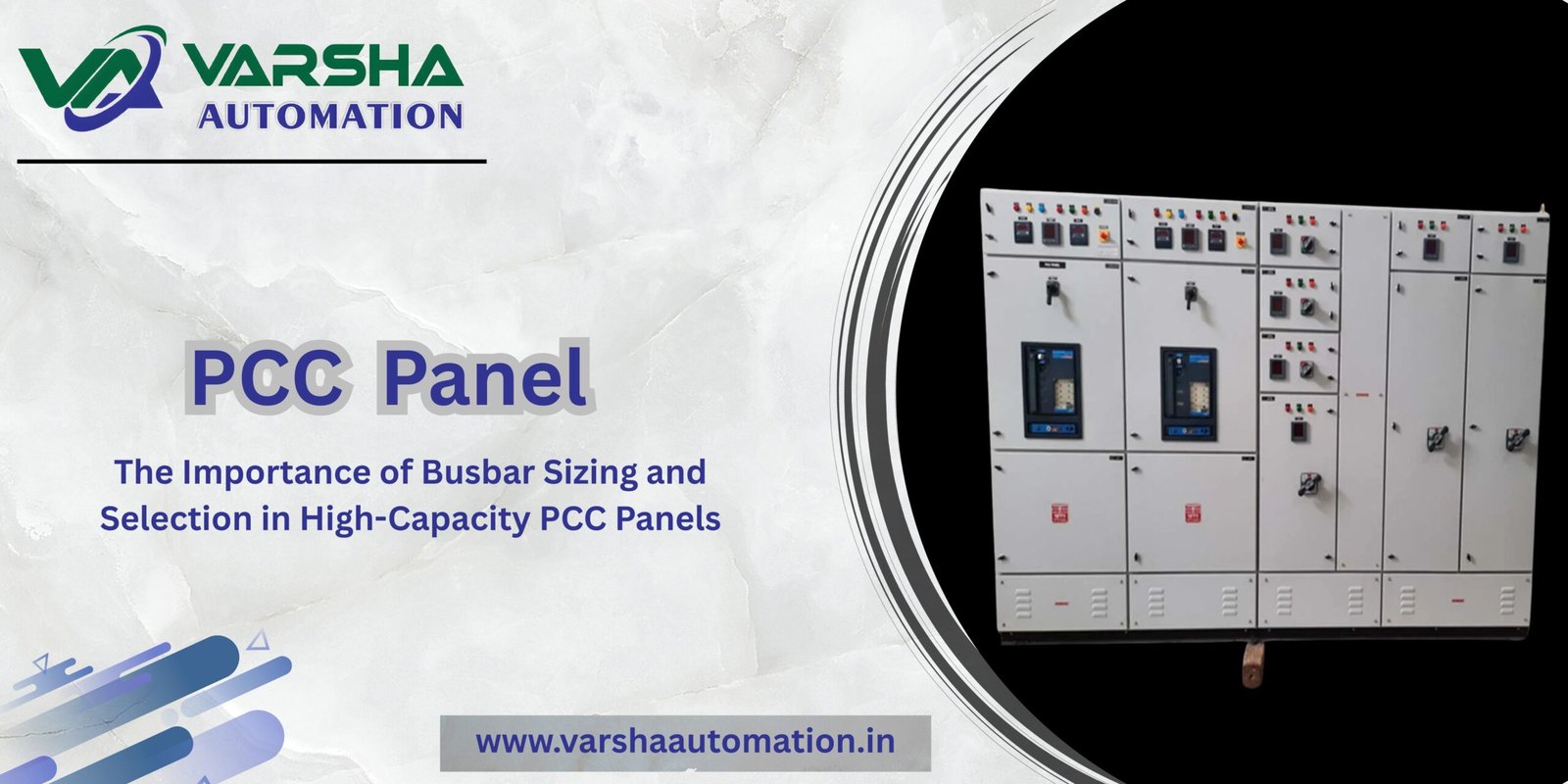
The Importance of Busbar Sizing and Selection in High-Capacity PCC Panels
In a Power Control Center (PCC), the busbar acts as the highway for electrical energy. It collects bulk electrical current from primary sources—such as main distribution transformers or heavy industrial diesel generators—and routes it safely to various outgoing air circuit breakers (ACBs) and molded case circuit breakers (MCCBs).
When engineering a high-capacity PCC panel (typically handling currents from 800A up to 6300A), busbar sizing and selection is the most critical design decision. An undersized busbar leads to excessive temperature rise, energy losses, and catastrophic insulation failures under short-circuit conditions.
Below, we break down the engineering fundamentals behind choosing and sizing busbars for high-performance Power Control Centers.
Material Selection: Copper (Cu) vs. Aluminum (Al)
The first choice every design engineer faces is selecting the conductor material. Both copper and aluminum have distinct physical, mechanical, and economic properties.
Copper Busbars
Copper is the gold standard for high-performance and space-constrained panel configurations.
High Conductivity: Copper has approximately 1.6 times the electrical conductivity of aluminum.
Compact Footprint: Because of high conductivity, copper busbars require a much smaller cross-sectional area to carry the same current, leading to compact panel designs.
Lower Contact Resistance: Copper oxide is relatively conductive and soft, ensuring reliable electrical joints over time.
Aluminum Busbars
Aluminum is highly preferred in large-scale projects where weight reduction and cost-efficiency are paramount.
Cost-Effective: Aluminum is significantly cheaper and lighter than copper, making the overall switchgear cabinet much more economical.
Thermal Expansion Challenges: Aluminum has a higher thermal expansion coefficient and is prone to “cold flow” (creeping under mechanical pressure), requiring specialized spring washers (like Belleville washers) at joint points to prevent loosening.
Engineering Standard at Varsha Automation: For heavy chemical plants, textile processing facilities, and coastal areas where corrosive vapors are present, we strictly recommend tinned copper busbars to prevent joint degradation and galvanic corrosion. You can review our manufacturing standards on our Varsha Automation Home page.
2. The Science of Busbar Sizing: Key Engineering Factors
Sizing a busbar is not just about matching a current rating to a look-up table. Engineers must calculate multiple intersecting physical variables:
A. Current Density Limits
Current density is the ratio of current ($I$) to the cross-sectional area ($A$) of the busbar. As a rule of thumb, under natural air-cooled conditions inside an industrial panel:
Copper Current Density: Typically designed around $1.0\text{ to }1.2\text{ A/mm}^2$ depending on the temperature rise limit.
Aluminum Current Density: Typically designed around $0.65\text{ to }0.8\text{ A/mm}^2$.
B. Temperature Rise Limits (IEC 61439 Compliance)
According to global electrical switchgear standards, the maximum temperature of a busbar joint must not exceed specific safety limits (typically $105^\circ\text{C}$ absolute temperature under full load, assuming a $40^\circ\text{C}$ ambient engine-room temperature). Overheating degrades the busbar support insulators, leading to structural failures.
C. Short-Circuit Fault Currents (Mechanical Stress)
When a massive short-circuit fault occurs (e.g., 50kA for 1 second), the magnetic fields generated between the parallel busbar phases exert massive mechanical forces (forces of attraction and repulsion). The busbar and its supports must be physically rigid enough to withstand these forces without bending or fracturing.
3. Integration with Low-Voltage Switchgear
A properly sized busbar must align perfectly with the incoming and outgoing terminal links of major switchgear. If a 3200A Air Circuit Breaker (ACB) is installed in the PCC, the main busbar run must feature custom-bent, flexible copper droppers to prevent terminal stress on the breaker’s physical mounting base.
For systems that automate motor loads downstream, these mains busbar runs feed directly into highly efficient motor protection systems. Read more about motor protection layouts in our comprehensive guide on MCC Panels.
Secure Your Electrical Infrastructure with CPRI-Standard Layouts
Under-engineered power systems are a ticking financial bomb for any manufacturing facility. Ensuring that your low-tension (LT) switchgear is configured with the correct current density, phase clearances, and thermal safety margins prevents unplanned factory shutdowns.
Are you looking for certified, heavy-duty power distribution systems with precision-designed busbar networks? Explore our engineered PCC Panels or contact our Ahmedabad technical center today to discuss your plant’s electrical load profile.
Looking to integrate smart speed controls and automation downstream? Discover our high-reliability range of VFD Panels and programmable PLC Scada Panels.