




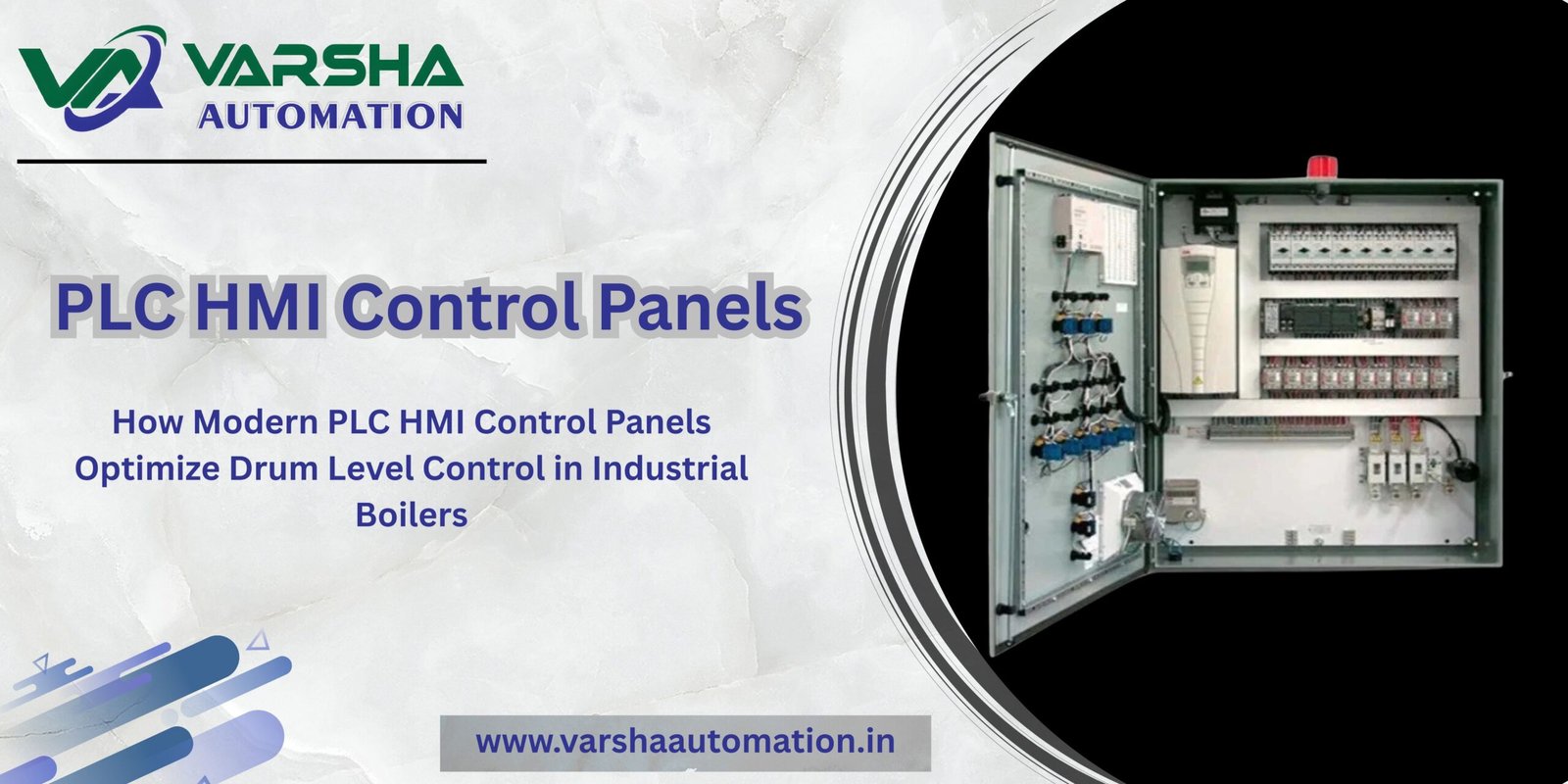
How Modern PLC HMI Control Panels Optimize Drum Level Control in Industrial Boilers
In an industrial steam boiler, maintaining the correct water level inside the steam drum is a delicate balancing act. If the water level drops too low, the boiler tubes are exposed to extreme radiant heat without adequate cooling, leading to thermal stress, tube ruptures, and catastrophic mechanical failure. Conversely, if the water level rises too high, water droplets carry over into the steam outlet, damaging downstream steam turbines, valves, and piping through water hammer and corrosion.
Managing this balance manually is virtually impossible due to two deceptive physical phenomena known as Shrink and Swell.
To maintain equilibrium, modern process plants rely on customized PLC HMI Control Panels. These panels implement advanced multi-element control logic to manage feed-water pumps and maintain the perfect drum level under fluctuating steam demands.
1. Deceptive Dynamics: Understanding Shrink and Swell Effects
When steam demand changes rapidly, the water level inside the boiler drum reacts in counter-intuitive ways that can confuse basic single-sensor systems.
The Swell Effect: When a downstream valve suddenly opens to draw more steam, the pressure inside the boiler drum drops. This sudden pressure drop causes steam bubbles trapped under the water surface to rapidly expand. As a result, the water level appears to rise, even though the actual mass of the water inside the boiler has decreased.
The Shrink Effect: Conversely, when steam demand drops suddenly, the drum pressure increases. This pinches the steam bubbles, causing the water level to appear to drop, even though no water mass has been lost.
A standard mechanical level regulator can be fooled by these effects—reducing feed-water when it should be increasing it, and vice versa. A programmable logic controller (PLC) overcomes this by looking at multiple sensor inputs simultaneously.
2. Evolution of Control Loops: Single to Three-Element Logic
Depending on the size, capacity, and load fluctuations of your boiler system, your automation panel can be programmed using one of three primary control methodologies.
Single-Element Control
How it Works: The PLC tracks only one input parameter: the Boiler Drum Level (typically measured by a differential pressure transmitter or guided wave radar). The controller compares this reading against the desired setpoint and adjusts the feed-water control valve accordingly.
Best For: Small, low-capacity boilers with steady, predictable steam demands where shrink and swell effects are minimal.
Two-Element Control
How it Works: The PLC tracks two distinct parameters: the Drum Level and the Steam Flow Rate. By measuring the steam leaving the boiler, the PLC can immediately anticipate water loss. If steam flow increases, the PLC opens the feed-water valve before the drum level has a chance to drop.
Best For: Medium-sized industrial boilers experiencing moderate load changes.
Three-Element Control
How it Works: This is the gold standard for high-capacity industrial boiler panels. The PLC processes three separate process variables: Drum Level, Steam Flow Rate, and Feed-water Flow Rate. By balancing the incoming water flow exactly against the outgoing steam flow, the PLC completely neutralizes the confusing effects of shrink and swell, maintaining a completely stable water level even during sudden plant-wide production spikes.
3. The Power of Integrated HMI Visualization
A PLC handles the back-end mathematical logic, but the Human-Machine Interface (HMI) touchscreen mounted on the front of the panel door gives plant operators total operational control.
Real-Time Trend Graphics: HMIs plot live graphs showing steam flow vs. feed-water flow, allowing operators to spot process anomalies instantly.
Alarm Management: If water levels approach critical thresholds, the HMI triggers auditory visual alerts and flashes safety interlock statuses before an automated “Low-Low Water” safety shutdown occurs.
4. Aligning Boiler Automation with Plant Infrastructure
A precision boiler drum level system does not operate in a vacuum. It serves as a vital component within a factory’s broader power and control architecture.
The core automation software and high-level graphics configured for the boiler area feed directly into a facility’s main centralized control network. You can explore how these facility-wide monitoring systems are engineered in our ultimate guide to PLC Scada Panels.
Furthermore, because feed-water pumps require immense motor power to pump water into a pressurized drum, operating them at a single fixed speed wastes significant electricity. To combat this, modern automation layouts connect the PLC outputs to specialized VFD Panels to continuously modulate pump motor speeds, resulting in massive factory energy savings. These systems are powered directly upstream by heavy-duty switchgear hubs, which you can read about in our structural breakdown of PCC Panels.
Secure Your Boiler Operations with Varsha Automation
Implementing advanced three-element control logic requires deep application knowledge, proper instrumentation isolation, and rugged panel manufacturing capable of enduring high thermal environments. Investing in high-grade boiler automation safeguards your plant’s most expensive utility asset.
Are you looking to upgrade an outdated, unreliable analog boiler panel to a modern, safe, PLC-driven control system? Explore our comprehensive line of custom PLC Scada Panels.
Looking for heavy-duty motor control centers to house your facility’s utility breakers and starter circuits? View our high-performance MCC Panels or contact our technical engineering desk in Ahmedabad today to clear your system drawings.