




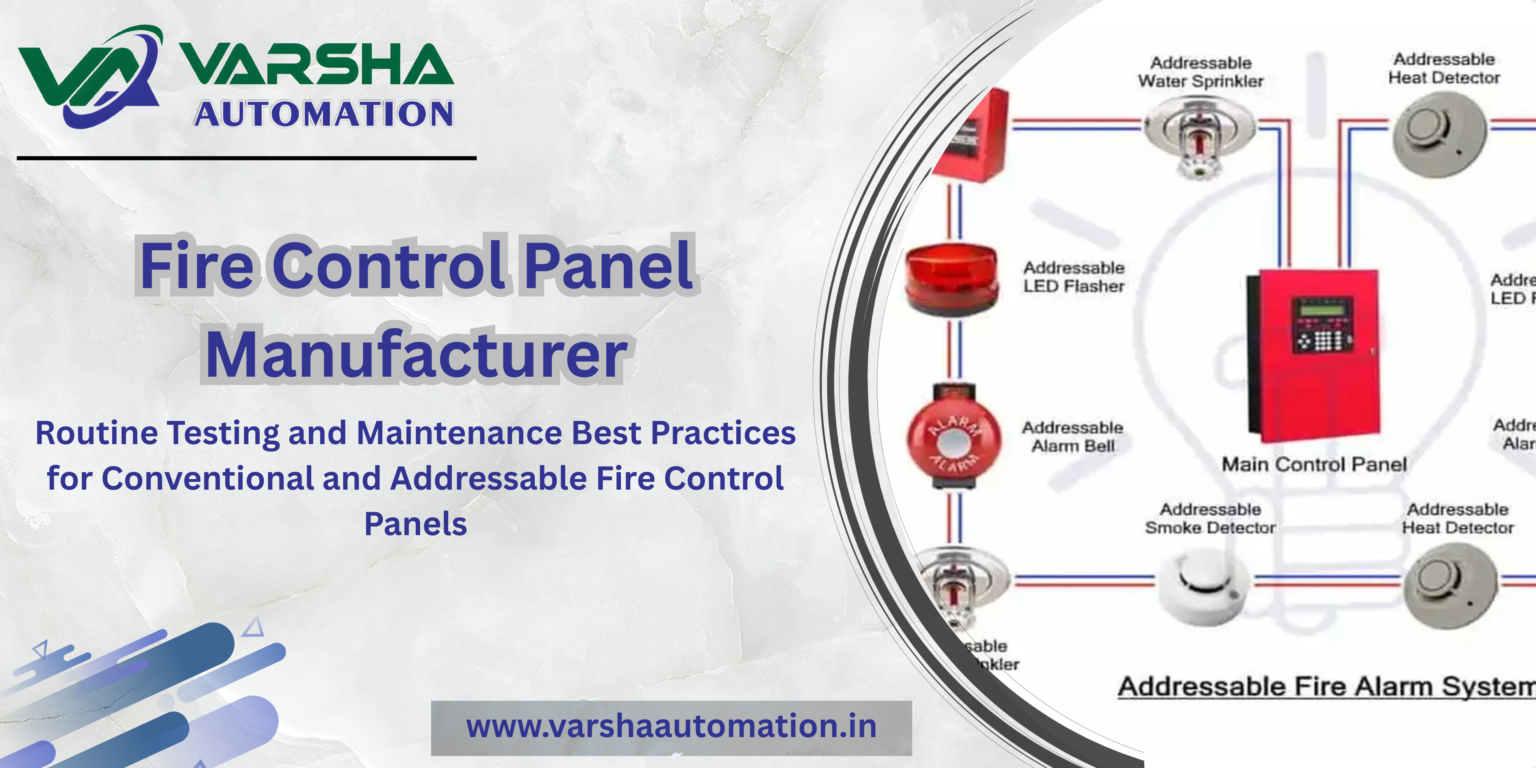
Routine Testing and Maintenance Best Practices for Conventional and Addressable Fire Control Panels
In heavy manufacturing plants, complex industrial complexes, automated warehouses, and continuous production facilities, life-safety fire alarm systems serve as the ultimate defense against catastrophic fire emergencies. However, sophisticated fire detection and mitigation equipment is susceptible to environmental dust accumulation, electronic component aging, wiring degradation, and standby battery capacity loss over extended operating cycles.
Maintaining absolute operational readiness and ensuring fault-free system performance depends fundamentally on structured testing protocols for an engineered Fire Control Panel.
A fire alarm control panel manages continuous diagnostic polling across detection loops, monitors standby battery health, and supervises notification appliance circuits to guarantee immediate response during hazard events.
Neglecting routine testing and maintenance schedules leads to undetected open detection circuits, degraded battery backup capacity, nuisance alarm desensitization, false sprinkler activations, and catastrophic life-safety system failure during emergencies. Understanding the core theoretical principles governing addressable loop polling, conventional zone supervision, battery discharge testing, and sensor calibration allows facility managers to maintain foolproof safety networks. This comprehensive technical guide provides an in-depth theoretical analysis of routine testing and maintenance best practices for conventional and addressable fire control panels.
Theoretical Architecture of System Supervision and Diagnostics
Industrial fire control panels utilize continuous electronic supervision algorithms to monitor the physical and electrical integrity of every connected device across the facility:
+-----------------------------------------------------------------+
|                  CONTINUOUS LOOP END-OF-LINE SUPERVISION        |
| (Monitors continuous low-voltage current flow for open circuits)|
+-----------------------------------------------------------------+
                                  |
                                  v
+-----------------------------------------------------------------+
|               ADDRESSABLE POLLING & SENSOR VERIFICATION         |
| (Exchanges digital heartbeat packets with individual detectors) |
+-----------------------------------------------------------------+
                                  |
                                  v
+-----------------------------------------------------------------+
|             STANDBY BATTERY CAPACITY & CHARGE MONITORING        |
| (Verifies DC power reserves and automatic trickle-charge health) |
+-----------------------------------------------------------------+
1. Addressable Polling versus Conventional Zone Supervision
-
Theoretical Principle: Conventional fire panels monitor linear detection circuits using end-of-line resistors, where a continuous low-voltage supervision current flows through all detectors. An open circuit or ground fault breaks this current path, triggering a general trouble signal.
-
Addressable Digital Polling: Addressable fire panels transmit digital interrogation packets to every individual sensor on a communication loop. The panel verifies each detector’s unique address, sensitivity drift compensation status, and environmental chamber cleanliness continuously, eliminating blind spots.
2. Standby Battery Health and Power Reserve Verification
-
Theoretical Principle: In the event of a primary utility power outage, the fire alarm control panel must switch instantaneously to dedicated secondary standby batteries without interrupting processing logic or supervisory monitoring.
-
Capacity Assurance: Routine maintenance protocols verify that internal battery chargers maintain optimal float voltages and that battery packs can sustain required supervisory loads followed by full alarm notification demands for mandatory regulatory durations.
System Integration Across Industrial Control Networks
Maintained fire alarm control panels interface as the premier life-safety supervisory node across integrated industrial automation infrastructure:
-
Primary Life-Safety & Hazard Supervision: System testing, diagnostic logging, and emergency coordination are managed via a certified Fire Control Panel.
-
Thermal Process & Boiler Safety: Combustion safety interlocks and burner management testing are coordinated through a specialized Boiler Control Panel.
-
Supervisory SCADA Telemetry Integration: Fire panel trouble alerts, supervisory states, and alarm histories stream into an intelligent PLC Scada Panel for central plant monitoring.
-
Emergency Power Backup Coordination: Standby generator emergency power supplies and transfer logic interface with an automated Synchronize panel.
-
Electrical Distribution Infrastructure: Primary power feeding fire alarm system battery chargers is routed through a central Power Panel or heavy-duty PCC Panel (Power Control Center), while auxiliary motor equipment is managed via modular MCC Panel and VFD Panel units.
Theoretical Best Practices for Fire Panel Maintenance
To ensure absolute system dependability and compliance during routine facility audits, maintenance engineers adhere to three core theoretical guidelines:
-
Establish Scheduled Addressable Calibration Audits: Review addressable sensor sensitivity logs through the fire panel interface routinely to identify and clean detectors affected by industrial dust accumulation.
-
Perform Simulated Power-Loss Battery Load Tests: Conduct periodic primary power disconnection tests to verify that standby batteries transition the fire panel seamlessly without resetting system memory or dropping communication loops.
-
Maintain Comprehensive Digital Event History Logs: Archive historical trouble signals, supervisory events, and alarm logs within the fire panel memory to track recurring circuit intermittent faults and component wear.
Conclusion
Implementing routine testing and maintenance best practices for conventional and addressable fire control panels is essential for ensuring absolute life-safety reliability in industrial facilities. By verifying addressable loop communication, maintaining standby battery reserve capacity, and conducting scheduled sensor audits, industrial plants guarantee that their fire protection systems operate flawlessly when emergencies occur.
Looking for Custom Fire Control Panels and Advanced Industrial Automation Solutions? Explore our full lineup of critical Fire Control Panel solutions, specialized Boiler Control Panel designs, automated PLC Scada Panel architectures, generator Synchronize panel systems, variable-speed VFD Panel modules, centralized MCC Panel drawers, main Power Panel systems, and heavy-duty PCC Panel assemblies at Varsha Automation. Contact our expert engineering team today.