




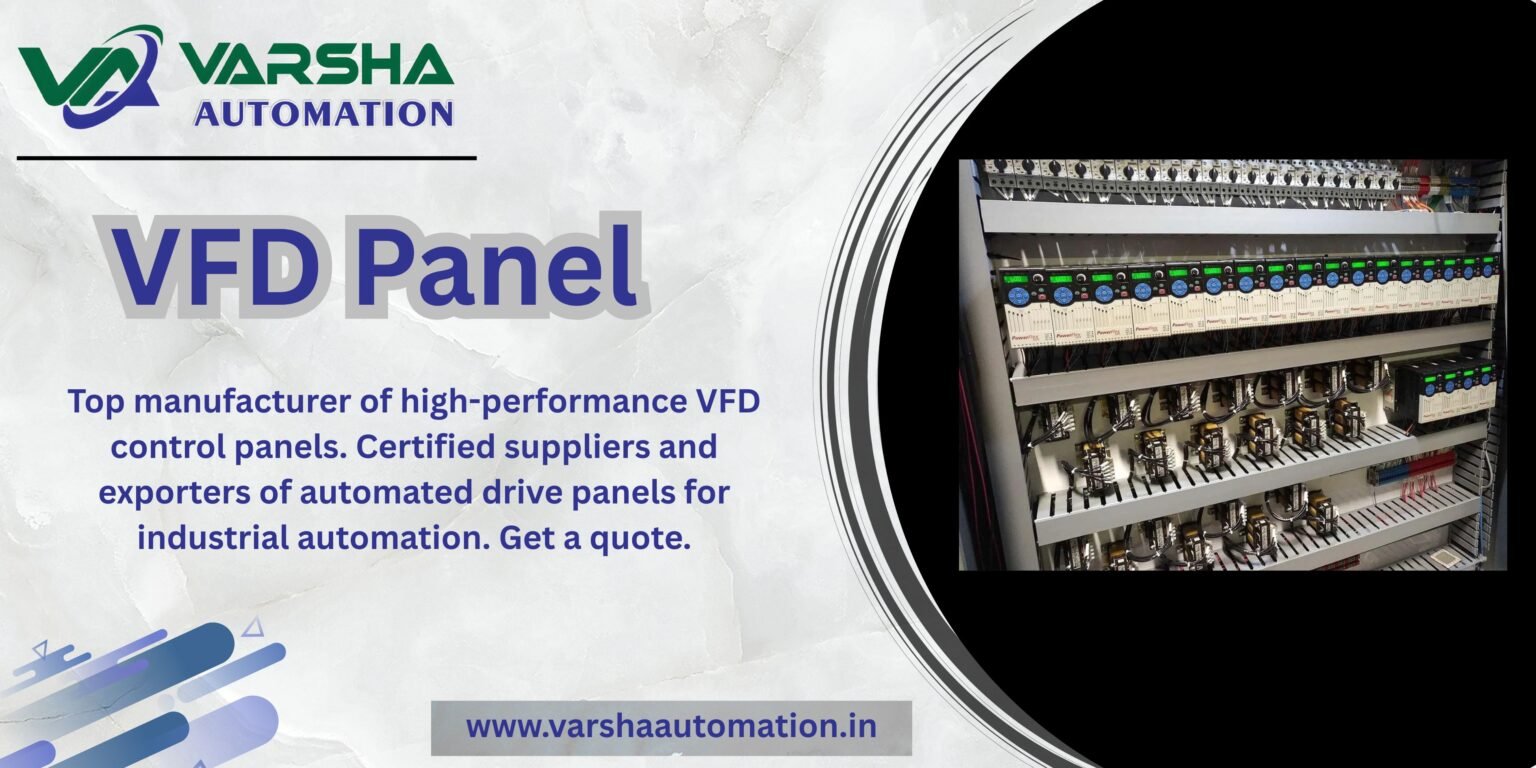
VFD Panel Manufacturer In Ahmedabad , Gujarat , India
In today’s industrial environment, energy efficiency, precise motor control, and operational reliability are critical factors for achieving high productivity and reducing operating costs. Industries worldwide are increasingly adopting advanced motor control technologies to optimize performance while minimizing energy consumption. One of the most effective solutions for achieving these objectives is the VFD Panel.
A VFD Panel, also known as a Variable Frequency Drive Panel, is designed to control the speed, torque, and operation of electric motors by regulating the frequency and voltage supplied to them. By providing accurate motor speed control, VFD Panels help industries improve process efficiency, reduce energy consumption, extend equipment life, and enhance overall system performance.
VFD Panels are widely used in manufacturing plants, water treatment facilities, HVAC systems, food processing units, chemical industries, pharmaceutical plants, textile mills, power plants, and many other industrial sectors where motor-driven equipment plays a crucial role.
As industries move toward automation and energy-efficient operations, VFD Panels have become an essential component of modern electrical and industrial control systems.
What is a VFD Panel?
A VFD Panel (Variable Frequency Drive Panel) is an electrical control panel that houses a Variable Frequency Drive and associated components used to control the speed and operation of AC electric motors.
The panel adjusts the frequency and voltage supplied to the motor, allowing operators to precisely control motor speed according to process requirements.
Unlike conventional motor starters that operate motors at fixed speed, VFD Panels provide variable speed control, enabling motors to run only at the required speed, thereby saving energy and improving process control.
The panel typically includes:
- Variable Frequency Drive
- Circuit Breakers
- Contactors
- Overload Protection Devices
- Control Relays
- Cooling Systems
- PLC Integration
- HMI Interface
- Monitoring Instruments
Importance of VFD Panels in Modern Industries
Electric motors account for a significant portion of industrial power consumption. Operating motors continuously at full speed often results in energy wastage and unnecessary mechanical stress.
VFD Panels help solve these challenges by providing intelligent motor control.
Energy Savings
Motor speed can be adjusted according to actual demand.
Reduced Power Consumption
Lower motor speeds significantly reduce energy usage.
Improved Process Control
Precise speed regulation enhances production quality.
Extended Equipment Life
Soft starting reduces mechanical wear and stress.
Lower Maintenance Costs
Reduced strain on motors and mechanical systems minimizes repairs.
Enhanced Operational Efficiency
Processes operate more smoothly and efficiently.
Working Principle of a VFD Panel
A VFD Panel controls motor speed by modifying the frequency and voltage supplied to the motor.
Step 1: AC Power Input
The VFD receives standard AC power from the electrical supply.
Step 2: Rectification
The incoming AC power is converted into DC power using a rectifier.
Step 3: DC Bus Section
The DC power is filtered and stabilized.
Step 4: Inversion
The inverter converts DC power back into AC power at the desired frequency and voltage.
Step 5: Motor Speed Control
The modified AC output is supplied to the motor.
By changing the output frequency, the motor speed can be increased or decreased as required.
Step 6: Continuous Monitoring
The VFD continuously monitors operating conditions to ensure efficient and safe operation.
Main Components of a VFD Panel
Variable Frequency Drive
The core component responsible for speed control.
MCCB or Circuit Breaker
Provides protection against short circuits and overloads.
Contactor
Controls motor operation and isolation.
Overload Relay
Protects the motor from excessive current.
Cooling Fan
Maintains proper operating temperature inside the panel.
Control Transformer
Provides control voltage for auxiliary components.
PLC System
Supports automation and process control.
HMI Display
Allows operators to monitor and control system parameters.
Input and Output Filters
Reduce electrical noise and harmonics.
Bus Bars
Distribute electrical power within the panel.
Types of VFD Panels
Standard VFD Panel
Used for general industrial motor control applications.
Suitable for:
- Pumps
- Fans
- Conveyors
- Blowers
Automatic VFD Panel
Operates automatically based on process conditions.
Ideal for automated production systems.
PLC-Based VFD Panel
Integrated with programmable logic controllers.
Provides advanced process control capabilities.
Multi-Drive VFD Panel
Controls multiple motors from a single panel.
Used in large industrial installations.
HVAC VFD Panel
Designed specifically for HVAC systems.
Controls:
- Air Handling Units
- Cooling Towers
- Ventilation Fans
- Chillers
Applications of VFD Panels
VFD Panels are used in numerous industries.
Water Treatment Plants
Control pump speeds according to demand.
Benefits
- Energy savings
- Improved flow control
- Reduced water hammer effects
HVAC Systems
Regulate fan and blower speeds.
Benefits
- Lower energy consumption
- Improved climate control
- Reduced equipment wear
Manufacturing Industry
Control conveyors, mixers, and production equipment.
Benefits
- Improved process accuracy
- Higher productivity
Textile Industry
Control spinning and weaving machinery.
Benefits
- Consistent product quality
- Reduced yarn breakage
Food Processing Industry
Operate mixers, conveyors, and packaging equipment.
Benefits
- Better process control
- Improved efficiency
Chemical Industry
Control pumps, agitators, and process machinery.
Benefits
- Precise flow regulation
- Enhanced process stability
Pharmaceutical Industry
Maintain accurate motor speeds in production systems.
Benefits
- Improved product consistency
- Enhanced process reliability
Benefits of Using a VFD Panel
Significant Energy Savings
One of the biggest advantages of VFD technology is energy efficiency.
For variable torque applications such as pumps and fans, energy savings can be substantial.
Soft Motor Starting
Gradual acceleration reduces inrush current and mechanical shock.
Improved Process Control
Operators can adjust motor speed precisely according to process needs.
Reduced Mechanical Stress
Lower stress extends equipment life.
Lower Maintenance Costs
Smooth operation reduces wear on motors and mechanical components.
Increased Productivity
Optimized motor operation improves overall system performance.
Better Power Factor
Modern VFDs contribute to improved electrical efficiency.
VFD Panel vs Traditional Motor Starter
Traditional Starter
- Fixed motor speed
- High starting current
- Limited control
- Higher energy consumption
VFD Panel
- Variable speed operation
- Soft starting capability
- Advanced control features
- Improved energy efficiency
For applications requiring speed control and energy optimization, VFD Panels are clearly the preferred solution.
Features of Modern VFD Panels
Today’s VFD Panels include advanced technologies such as:
PLC Integration
Supports automated industrial processes.
Touchscreen HMI
Provides user-friendly operation.
Remote Monitoring
Allows system supervision from remote locations.
SCADA Connectivity
Integrates with plant-wide monitoring systems.
Energy Monitoring
Tracks power consumption and performance.
Fault Diagnostics
Provides detailed fault analysis and troubleshooting.
IoT Integration
Supports Industry 4.0 initiatives.
Factors to Consider When Selecting a VFD Panel
Motor Power Rating
Choose a VFD compatible with motor capacity.
Load Characteristics
Different applications require different VFD configurations.
Environmental Conditions
Consider dust, temperature, humidity, and installation location.
Automation Requirements
Evaluate communication and control system needs.
Harmonic Mitigation
Large installations may require harmonic filters.
Future Expansion
Allow for additional equipment integration.
Compliance Standards
Ensure adherence to electrical and industrial regulations.
Maintenance of VFD Panels
Proper maintenance ensures reliable long-term performance.
Clean Cooling Systems
Prevent overheating by maintaining airflow.
Inspect Electrical Connections
Loose connections can cause failures.
Check Cooling Fans
Ensure proper operation of ventilation systems.
Monitor Operating Parameters
Regularly review voltage, current, and temperature.
Update Software
Maintain the latest firmware and control settings.
Perform Preventive Maintenance
Routine inspections reduce downtime and repair costs.
Future of VFD Panel Technology
Industrial automation continues to drive innovation in motor control systems.
Emerging developments include:
- AI-Based Motor Optimization
- Smart Energy Management
- Predictive Maintenance
- Cloud Connectivity
- Advanced Analytics
- Digital Twin Technology
- IoT Integration
- Industry 4.0 Compatibility
These technologies are helping industries achieve greater efficiency, reliability, and sustainability.
Why VFD Panels are Essential for Modern Industries
As energy costs continue to rise and industries seek greater efficiency, VFD Panels provide an effective solution for optimizing motor performance and reducing operating expenses.
Their ability to control speed accurately, improve process quality, reduce energy consumption, and extend equipment life makes them indispensable in modern industrial operations.
Whether controlling pumps, fans, conveyors, compressors, mixers, or production machinery, VFD Panels offer significant advantages that contribute directly to operational success.
Conclusion
A VFD Panel (Variable Frequency Drive Panel) is a highly efficient motor control solution that enables precise speed regulation, energy savings, and improved process performance. By controlling the frequency and voltage supplied to electric motors, VFD Panels help industries optimize operations while reducing power consumption and maintenance costs.
From manufacturing plants and water treatment facilities to HVAC systems and process industries, VFD Panels have become a key component of modern industrial automation. As technology continues to evolve, VFD Panels will play an increasingly important role in achieving energy efficiency, operational reliability, and sustainable industrial growth.